Ask Raul: Fonts and Encoding
Open PDFDocument date: 2004-08-09
Type: SIDtoday
Pages: 2
Genre: newsletter
Banner: DYNAMIC PAGE -- HIGHEST POSSIBLE CLASSIFICATION IS TOP SECRET // SI / TK // REL TO USA AUS CAN GBR NZL
Classification: UNCLASSIFIED
Dissemination: FOUO
The first in a series of articles on Digital Network Intelligence by "Raul," a fictional DNI analyst. This article explains the difference between fonts and encodings.
My notes
DYNAMIC PAGE -- HIGHEST POSSIBLE CLASSIFICATION IS
TOP SECRET // SI / TK // REL TO USA AUS CAN GBR NZL
SIDtoday
(U) Ask Raul: Fonts and Encoding
FROM: 'Raul', a DNI Analyst
Unknown
Run Date: 08/09/2004
(U//FOUO) Note from SIGINT Communications: This is the first of a
monthly series of articles on DNI (Digital Network Intelligence)
matters by guest columnist Raul:
(U) Hey, Raul! What's the difference between a font and a
character set encoding? Aren't they the same?
(U) Argh!!! If there is one thing that will drive old Raul crazy it is
hearing people -- people who have been through endless NSA
C2C/DNI courses -- referring to an encoding as a font or vice
versa. So, in order to help keep my blood pressure down, here's
how it works:
(U) A font is simply a collection of symbols (glyphs) of a particular
style and size. Fonts have names which may or may not be of any
use in figuring out what they cover. For example: Times, Times
New Roman, Arial, Helvetica, Times New Roman Cyrillic, Ivan's
Crazy Cyrillic, etc. For a given language or glyph set, the different
fonts are simply different styles of the same thing.
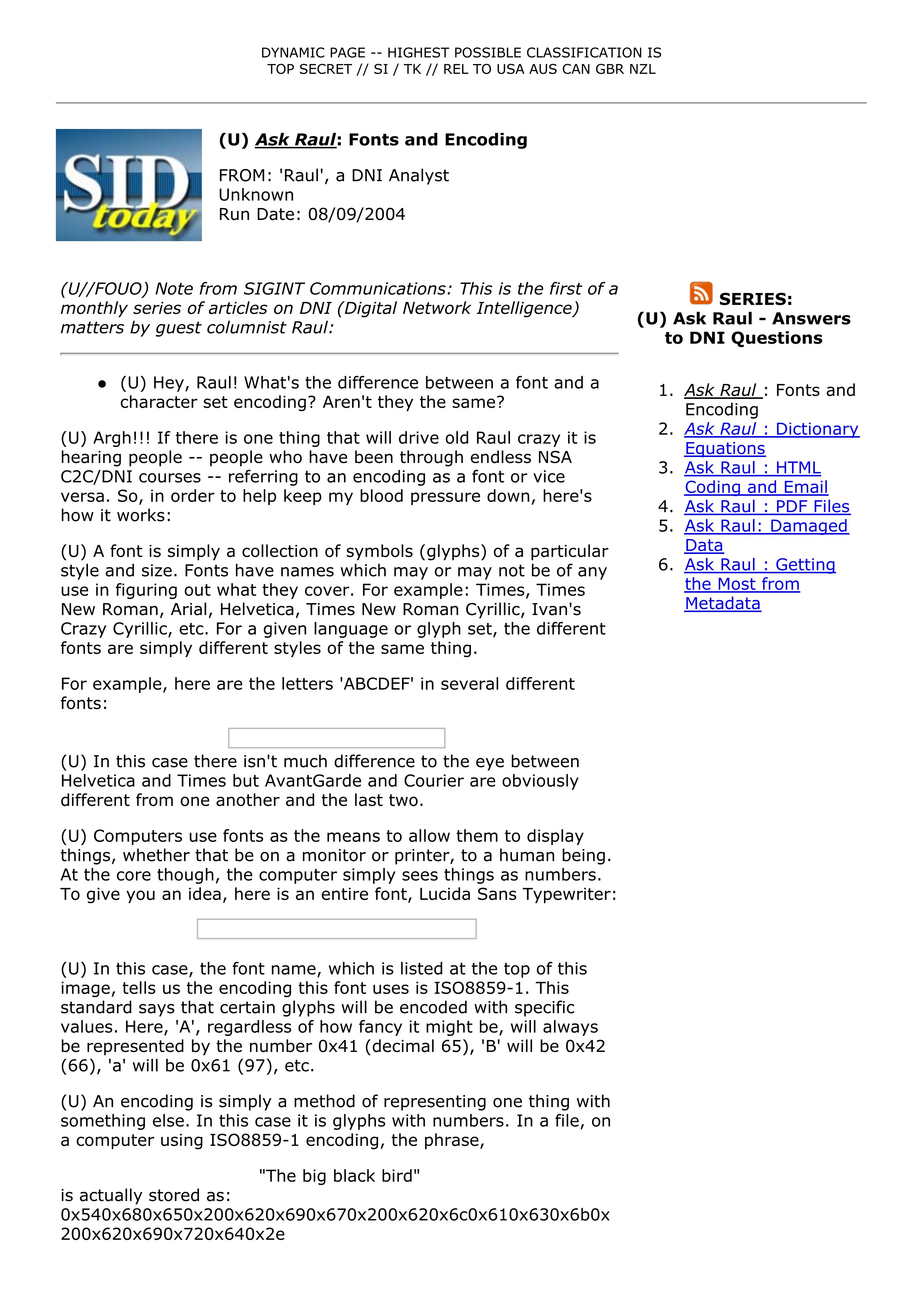
For example, here are the letters 'ABCDEF' in several different
fonts:
(U) In this case there isn't much difference to the eye between
Helvetica and Times but AvantGarde and Courier are obviously
different from one another and the last two.
(U) Computers use fonts as the means to allow them to display
things, whether that be on a monitor or printer, to a human being.
At the core though, the computer simply sees things as numbers.
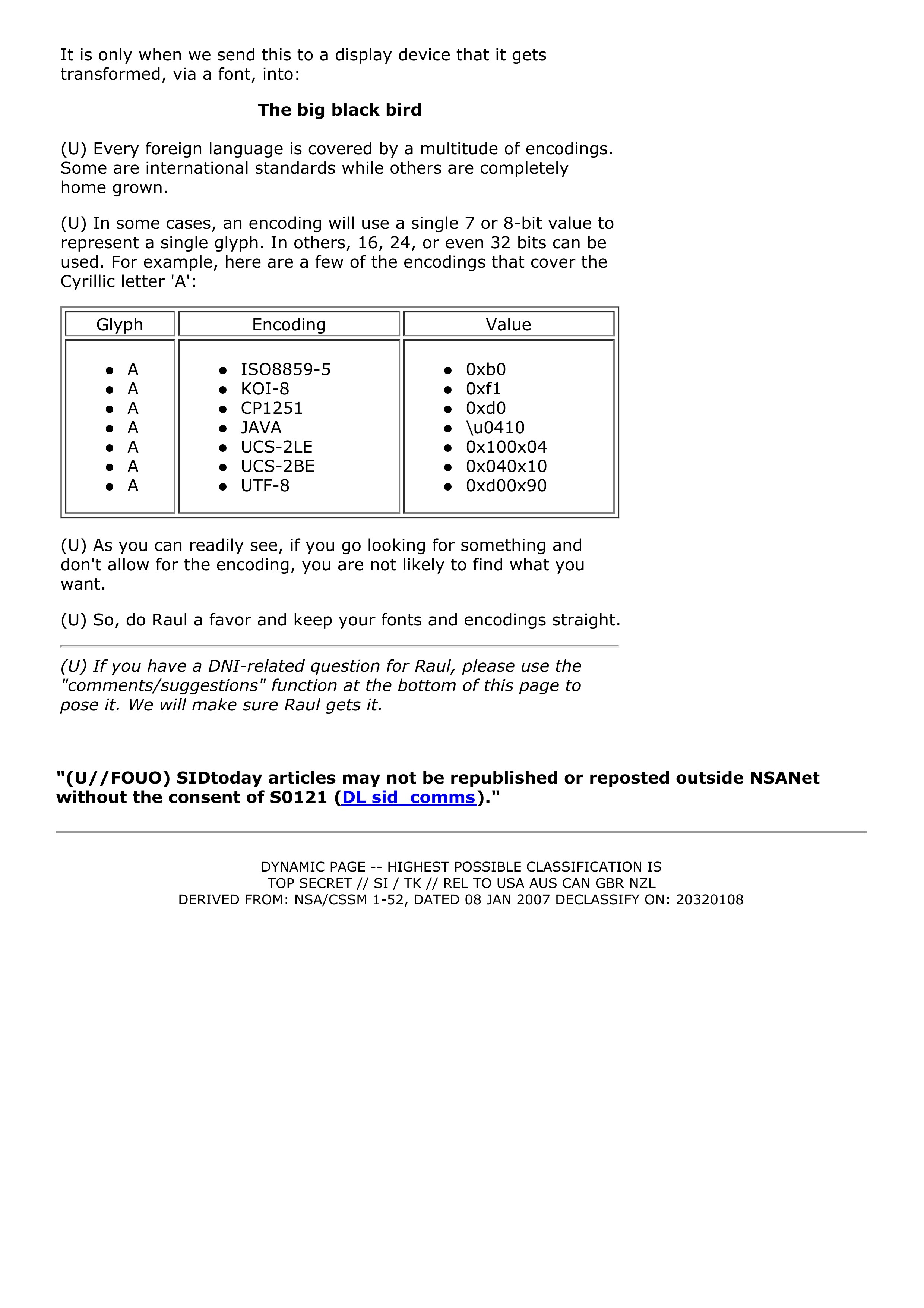
To give you an idea, here is an entire font, Lucida Sans Typewriter:
(U) In this case, the font name, which is listed at the top of this
image, tells us the encoding this font uses is ISO8859-1. This
standard says that certain glyphs will be encoded with specific
values. Here, 'A', regardless of how fancy it might be, will always
be represented by the number 0x41 (decimal 65), 'B' will be 0x42
(66), 'a' will be 0x61 (97), etc.
(U) An encoding is simply a method of representing one thing with
something else. In this case it is glyphs with numbers. In a file, on
a computer using ISO8859-1 encoding, the phrase,
"The big black bird"
is actually stored as:
0x540x680x650x200x620x690x670x200x620x6c0x610x630x6b0x
200x620x690x720x640x2e
SERIES:
(U) Ask Raul - Answers
to DNI Questions
- Ask Raul : Fonts and
Encoding - Ask Raul : Dictionary
Equations - Ask Raul : HTML
Coding and Email - Ask Raul : PDF Files
- Ask Raul: Damaged
Data - Ask Raul : Getting
the Most from
Metadata
It is only when we send this to a display device that it gets
transformed, via a font, into:
The big black bird
(U) Every foreign language is covered by a multitude of encodings.
Some are international standards while others are completely
home grown.
(U) In some cases, an encoding will use a single 7 or 8-bit value to
represent a single glyph. In others, 16, 24, or even 32 bits can be
used. For example, here are a few of the encodings that cover the
Cyrillic letter 'A':
| Glyph | Encoding | Value |
|---|---|---|
| A | ISO8859-5 | 0xb0 |
| A | KOI-8 | 0xf1 |
| A | CP1251 | 0xd0 |
| A | JAVA | \u0410 |
| A | UCS-2LE | 0x100x04 |
| A | UCS-2BE | 0x040x10 |
| A | UTF-8 | 0xd00x90 |
(U) As you can readily see, if you go looking for something and
don't allow for the encoding, you are not likely to find what you
want.
(U) So, do Raul a favor and keep your fonts and encodings straight.
(U) If you have a DNI-related question for Raul, please use the
"comments/suggestions" function at the bottom of this page to
pose it. We will make sure Raul gets it.
"(U//FOUO) SIDtoday articles may not be republished or reposted outside NSANet
without the consent of S0121 (DL sid_comms)."
DYNAMIC PAGE -- HIGHEST POSSIBLE CLASSIFICATION IS
TOP SECRET // SI / TK // REL TO USA AUS CAN GBR NZL
DERIVED FROM: NSA/CSSM 1-52, DATED 08 JAN 2007 DECLASSIFY ON: 20320108
Related Documents
-
Ask Raul: Fonts and Encoding (repost) SIDtoday [pdf]
(Repost) The first in a series of articles on Digital Network Intelligence by "Raul," a fictional DNI analyst. This article explains the difference between fonts and encodings.
The Intercept ↗ (2017-04-24) -
Ask Raul: HTML Coding and Email SIDtoday [pdf]
Raul describes, for the benefit of Digital Network Intelligence analysts who run into weird jumbles of characters such as "D", how HTML special characters work.
Marking: SECRETPrograms: LIONHEARTThe Intercept ↗ (2017-04-24) -
Ask Raul: Damaged Data SIDtoday [pdf]
Raul describes to Digital Network Intelligence analysts how to deal with damaged data. First, he recommends trying to understand how the intercepted data was damaged and fix the problem so it doesn't happen in the future. ("Remember, damage doesn't just happen, something causes it and it is definitely much better to prevent it than to try and fix it.") Then he goes through various techniques to discover where problems in damaged files are and how to attempt to repair them.
Marking: SECRETPrograms: ROCKSOLIDThe Intercept ↗ (2017-04-24) -
Ask Raul: Numeric Character Reference SIDtoday [pdf]
Raul describes, for the benefit of Digital Network Intelligence analysts who run into weird jumbles of characters such as "D", how HTML special characters work.
Marking: SECRETPrograms: LionheartThe Intercept ↗ (2017-04-24) -
Ask Raul: Getting the Most from Metadata SIDtoday [pdf]
Raul gives advice to Digital Network Intelligence analysts about squeezing the most value out of Microsoft Office document metadata. He shows examples from Word and Excel documents and explains how you can use pieces of metadata to track down all documents by a specific author, or specific company, without even having an email address or other hard selectors.
Marking: SECRETPrograms: PINWALEThe Intercept ↗ (2017-04-24)