Tag: internet 14 documents
Search documents matching “internet” →Free-text subjects the curators added. Unlike the other axes these are not necessarily from the documents' own vocabulary, so they are the loosest thing to browse by (and the most forgiving).
Graphs
By Banner
By Classification
Refine (combine with another filter, via search)
Sort: Title
Documents
-
How Does Your Target Use the Internet? A New Tool Can Help You Find Out SIDtoday [pdf]
A new tool combines open-source and commercial data with signals intelligence to track how targets access the internet. Possible uses include tracking target movement and steering collection “towards links with higher intelligence potential.”
Programs: DNOC Spiral IIThe Intercept ↗ (2018-03-01) -
Internet Remote-Access Accounts Now Available SIDtoday [pdf]
A new web application permits NSA employees to login to an unclassified version of their internal NSA account, through which they can access the open internet (in compliance with NSA policies) as well as certain open-source and subscription-based resources.
The Intercept ↗ (2019-05-29) -
Menwith Hill Internet Challenge SIDtoday [pdf]
Menwith Hill Station now has eight workstations to access the "non-attribution" internet and will soon install 33 more. The first analyst or team to use the new internet capability with significant success will be rewarded with a party in their honor.
Marking: CONFIDENTIALThe Intercept ↗ (2016-12-07) -
We Have an Internet Program Manager! SIDtoday [pdf]
SID has increased the number of connected internet terminals by almost 500 percent. A new internet program manager will be managing SID’s internet issues.
The Intercept ↗ (2016-08-10) -
A Tough Targeting Challenge: Skype SIDtoday [pdf]
At the end of 2005, the NSA faced a serious challenge in spying on Skype calls. Compared to traditional phone calls, Skype introduces issues with target identification, collection, tracking, and decryption. “At this time, SIGINT targets have a method to freely obscure their communications on the global Internet, thus hindering our ability to collect vital communications intelligence.”
People: Berson, TomThe Intercept ↗ (2018-03-01) -
GCHQ Intelligence Production Head Outlines Present and Future Priorities SIDtoday [pdf]
According to a talk recently given at NSA's UK base in Menwith Hill, counterterrorism absorbs most (30%) of GCHQ's resources. Afghanistan and China are given increasing attention, while Russia gets less. Long term, GCHQ foresees challenges in keeping up with the internet and "huge amounts of data", while peace is expected in Iraq.
People: Ashton, JonThe Intercept ↗ (2019-05-29) -
Making Use of Open Source Info SIDtoday [pdf]
A manager from the IT Directorate states that the intelligence community needs to make better use of open source information (i.e. information that's
Marking: CONFIDENTIALPrograms: OUTPARKSThe Intercept ↗ (2017-09-13) -
Making Use of Open Source Info (repost) SIDtoday [pdf]
A manager from the IT Directorate states that the intelligence community needs to make better use of open source information (i.e. information that's publicly available on the internet). The NSA will be installing a new network to replace its "woefully inadequate" internet connection but needs to take further steps to improve its analysis of these sources.
Marking: CONFIDENTIALPrograms: OUTPARKSThe Intercept ↗ (2017-09-13) -
National Security Agency: Overview Briefing [pdf]
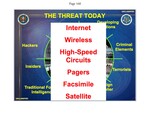
A slide from an unclassified NSA overview briefing, “The threat today”, which lists hackers, criminal elements, insiders and terrorists alongside technologies — the Internet, wireless, high-speed circuits, pagers, facsimile and satellite — as the threats the agency faces.
Marking: UNCLASSIFIED -
Putting the 'Gap' in AIRGAP SIDtoday [pdf]
AIRGAP is the NSA's "non-attribution Internet access" program that allows users to do research on the open internet. In 2005, it was run by "one of the world's largest ISPs," and the system was shared by the whole U.S. intelligence community. Some users were concerned that all of this internet traffic comes from the same IP address, which could be used to attribute internet traffic to the NSA, however technically there were often multiple IP addresses. The NSA is working on building its own new version of AIRGAP, that it doesn't share with the rest of the intelligence community. "Despite rules and warnings to the contrary, all too frequently users will use AIRGAP for registering on web sites or for services, logging into other sites and services and even ordering personal items from on-line vendors. By doing so, these users reveal information about themselves and, potentially, other users on the network. So much for 'non-attribution.'"
Marking: CONFIDENTIALThe Intercept ↗ (2017-09-13) -
Really Simple Syndication -- The Future of the Web SIDtoday [pdf]
An explanation of "one of the fastest growing technologies on the Internet," RSS, the format for web news feeds, and ways to use it within the NSA.
The Intercept ↗ (2016-12-07) -
The Syndication Standard: Will It Be RSS or Atom? SIDtoday [pdf]
A follow-up to an earlier article about RSS provides a description of a new competing syndication protocol called Atom.
The Intercept ↗ (2016-12-07) -
Upcoming Events Sponsored by the Institute for Analysis SIDtoday [pdf]
The Institute for Analysis is sponsored several events in 2006 bringing outside experts to discuss the future and technology, including Jesse Goldhammer, Peter Schwartz, and John Rendon.
Programs: ELMThe Intercept ↗ (2019-05-29) -
ZabaSearch.com: OPSEC Worry? SIDtoday [pdf]
The Internet Program Manager explains to anxious NSA staffers that public records information revealing addresses, phone numbers, and other personal information is now widely available on the web. "OPSEC/COMSEC concern? Sure. Is there anything you can do to mitigate it? No."
The Intercept ↗ (2017-09-13)