Country: Afghanistan 268 documents
Search documents matching “Afghanistan” →Countries mentioned in each document. A country may be mentioned directly (e.g., France) or inferred from a related reference, such as a city (Paris -> France) or a domain name (.fr -> France).
Graphs
By document date (11 years)
By Banner
By Classification
Refine (combine with another filter, via search)
Sort: Title
Documents
-
Generally Speaking: Supporting the Tactical Units SIDtoday [pdf]
The Signals Intelligence director says SID has done a good job delivering SIGINT to high-ranking commanders, but it hasn’t been as successful delivering to tactical units on the ground. He describes the work done so far to change that.
People: Quirk, RichardThe Intercept ↗ (2016-08-10) -
Getting Leads: GEO Mining SIDtoday [pdf]
Description of an approach to sifting through large amounts of phone call metadata to find leads for new surveillance target called "GEO Mining." The author gives an example of searching for heroin-production labs in Afghanistan using GEO Mining, by filtering all phone calls in Afghanistan down to calls made near known heroin-processing labs. In this case, "The top 20 handsets were then tasked for collection, and at least one has produced reportable intelligence."
People: Brown, PaulThe Intercept ↗ (2017-04-24) -
Ghosthunter and the geolocating of internet cafes [pdf]
This document announces an NSA “R Spotlight” webcast introducing GHOSTHUNTER, a multi-agency geolocation program designed to locate Time Division Multiple Access (TDMA) VSAT Internet access points, particularly internet cafés across the Middle East and North Africa in support of U.S. military operations. By mid-2009, GHOSTHUNTER had successfully geolocated over 5,000 VSAT terminals across Middle East demonstrating its operational effectiveness and integration with broader intelligence efforts.
Programs: GHOSTHUNTER -
GHOSTHUNTER Tasking Process [pdf]
The document outlines the GHOSTHUNTER (GH) tasking process at Menwith Hill Station, describing how geolocation requests for VSAT terminals and internet-connected targets are managed through coordination with the NSA’s Network Analysis Centre (NAC) and other sites. It details priority levels, task submission procedures, use of locational data from MASTERSHAKE, integration with imagery, and how results are shared with GCHQ and other authorized parties.
-
Global Collaboration Environment: Director’s talking points [pdf]
This NSA document reveals discussions between the agency and GCHQ about establishing a permanent joint surveillance facility in the UK to host the "SIGINT Seniors Europe" coalition, with both agencies coordinating messaging to overcome "persistent pushback" from some member nations. The memo indicates concerns that some European partners were reluctant due to "uncertainty on what missions the center will support, and associated concerns for European human rights laws," while the NSA preferred UK hosting as "optimal in terms of having the most flexibility in tuning the operation to benefit the Five Eyes."
-
Great Opportunities for Traveling SIGINTers SIDtoday [pdf]
The NSA needs signals intelligence analysts to volunteer to deploy to Iraq, Afghanistan, and the Horn of Africa.
Marking: CONFIDENTIALPrograms: VUPORTPeople: Quirk, RichardThe Intercept ↗ (2018-03-01) -
GSM tower mapping made easier and more accurate with new tool SIDtoday [pdf]
This document details DYMO, a prototype developed at the NSA’s Menwith Hill Station—the agency’s large British base operated in close cooperation with GCHQ—for highly accurate GSM tower geolocation. It highlights DYMO’s superior performance in mapping accuracy and metadata integrity, its extensive operational use across regions such as Iraq, Iran, and Somalia, and its integration with tools like GOLDENEYE and the Integrated COMINT System (ICS) to streamline analysis and intelligence fusion.
-
Guide to Using Contexts in XKS Fingerprints [pdf]
This technical guide explains how NSA analysts use "contexts" within XKEYSCORE fingerprints to create highly targeted surveillance queries by restricting searches to specific scopes (e.g., web searches, document bodies, geographic locations), enabling precision targeting such as finding "all people in Kabul performing web searches on Jihad" while avoiding the overwhelming noise of broader keyword searches.
-
Having the (SIGINT) Time of My Life! SIDtoday [pdf]
An NSA representative with a military task force in Afghanistan discusses how central signals intelligence is to war decisions. He writes that when the task force "'actions' a target, they head straight to the CSG [Cryptologic Support Group] and ask for information that almost always is the deciding factor on whether or not a 'target' is actioned. ... Isn't it awesome to be relevant?"
The Intercept ↗ (2017-09-13) -
High Powered Cordless Phones in the Af/Pak Border Area: Is UBL Talking? SIDtoday [pdf]
High Powered Cordless Phone networks include a base station and any number of phones, which operate similar to cellphones. The article author suspects Osama bin Laden might use one. HPCP networks are mapped in HOMEBASE.
Programs: HOMEBASEPeople: bin Laden, OsamaThe Intercept ↗ (2016-08-10) -
How Is Human Language Technology (HLT) Progressing? SIDtoday [pdf]
This document provides an operational update on the deployment of "HLT Labs"—a specialized suite of voice analytics designed to automate the discovery of intelligence "nuggets" within massive volumes of audio collection. The document highlights successful field applications in Afghanistan, Georgia, Texas, and Latin America, noting that these tools are becoming "force multipliers" that allow linguists to bypass manual listening in favor of automated keyword searching and speaker recognition.
-
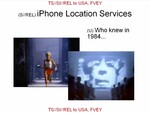
How the NSA Accesses Smartphone Data [pdf]
This document reveals how the NSA and its Five Eyes partners developed sophisticated methods to exploit iPhone location services and BlackBerry communications, framing smartphone users as “zombies” willingly sharing data. It includes examples of intercepted geolocation data and decrypted BlackBerry emails, illustrating targeted surveillance capabilities against both consumer and government communications.
-
ICP -- A New Concept for Support to Combatant Commanders SIDtoday [pdf]
A new concept called "Intelligence Campaign Planning" will integrate intelligence into the Combatant and Joint Task Force Commander's planning and operations processes.
Marking: SECRETThe Intercept ↗ (2016-12-07) -
Improving and Expanding War Zone Collection SIDtoday [pdf]
A new system targeting the Thuraya satellite phone network, intelligence from which was “responsible for the capture and/or termination of known terrorists,” has been launched. Kuwait City was the first of about 70 sites in the Middle East to receive the upgrade, which resulted in a six-fold increase in collection volume.
People: bin Laden, OsamaThe Intercept ↗ (2018-08-15) -
Improving Our Capability to Collect Against the Thuraya Satellite SIDtoday [pdf]
An upgraded system targeting the Thuraya satellite phone network has been installed in 23 sites across Europe, the Middle East and Central Asia. On an average day the systems collected "over 500,000 call events", including "20,000 calls of potential interest to NSA analysts."
The Intercept ↗ (2019-05-29) -
Intel for Deployed Commanders: NISTs SIDtoday [pdf]
NSA personnel have been deployed as part of National Intelligence Support Teams in Operation Enduring Freedom and Operation Iraqi Freedom. Teams consist of representatives from NSA, CIA, DIA, and the National Imagery and Mapping Agency in support of field commanders. “NIST brings NSA closer to the fight than any other program.”
The Intercept ↗ (2016-08-10) -
Intellipedia – Air Gapped Network Threats [pdf]
This document from an internal wiki for the U.S. intelligence community, surveys threats to so-called air-gapped systems, arguing that supply-chain compromises, physical implants (BIOS, KVMs, peripherals), infected removable media, and enabled wireless/emanations present realistic paths for adversaries to bridge isolated networks. It assesses likelihoods and attack vectors (including insider help and CDS/guard exploitation), highlights specific historic incidents (Agent.BTZ/MAKERSMARK), and recommends strict removable-media policies, TEMPEST countermeasures, and rigorous cross-domain guard protections to mitigate the risk.
People: Witte, Griff · Warren, Peter · Streeter, Michael · Watson, Paul · Louchard, Bjørn · Crawford, George · Rudge, David · Terrazas, Michael -
Interview with a SID "Hacker" -- Part 2: Hacker Culture and Worker Retention SIDtoday [pdf]
A SIDtoday internal NSA newsletter interview with a redacted TAO employee discussing hacker culture within the agency's offensive cyber unit, worker retention challenges, and the team's role in operations including the raid that killed Osama bin Laden.
Programs: SCQAWKPeople: bin Laden, Osama -
Interview with REDACTED Entering His 52nd Year at NSA SIDtoday [pdf]
An interview with an employee entering his 52nd year at the NSA. Looking back, morale at the agency was particularly low after "media coverage of misstatements about NSA and its mission", but overall, work ethic has changed for the better.
People: Caracristi, Ann Z.The Intercept ↗ (2019-05-29) -
Interview with... Deborah Maklowski, NSA/CSS Senior Intelligence Authority and IA Skill Community Advocate SIDtoday [pdf]
A senior intelligence official is interviewed about her career with the agency.
Programs: EGRAMThe Intercept ↗ (2016-12-07)